Why Does Rome Keep Showing Up?
Bread, Circuses, and the White House Lawn

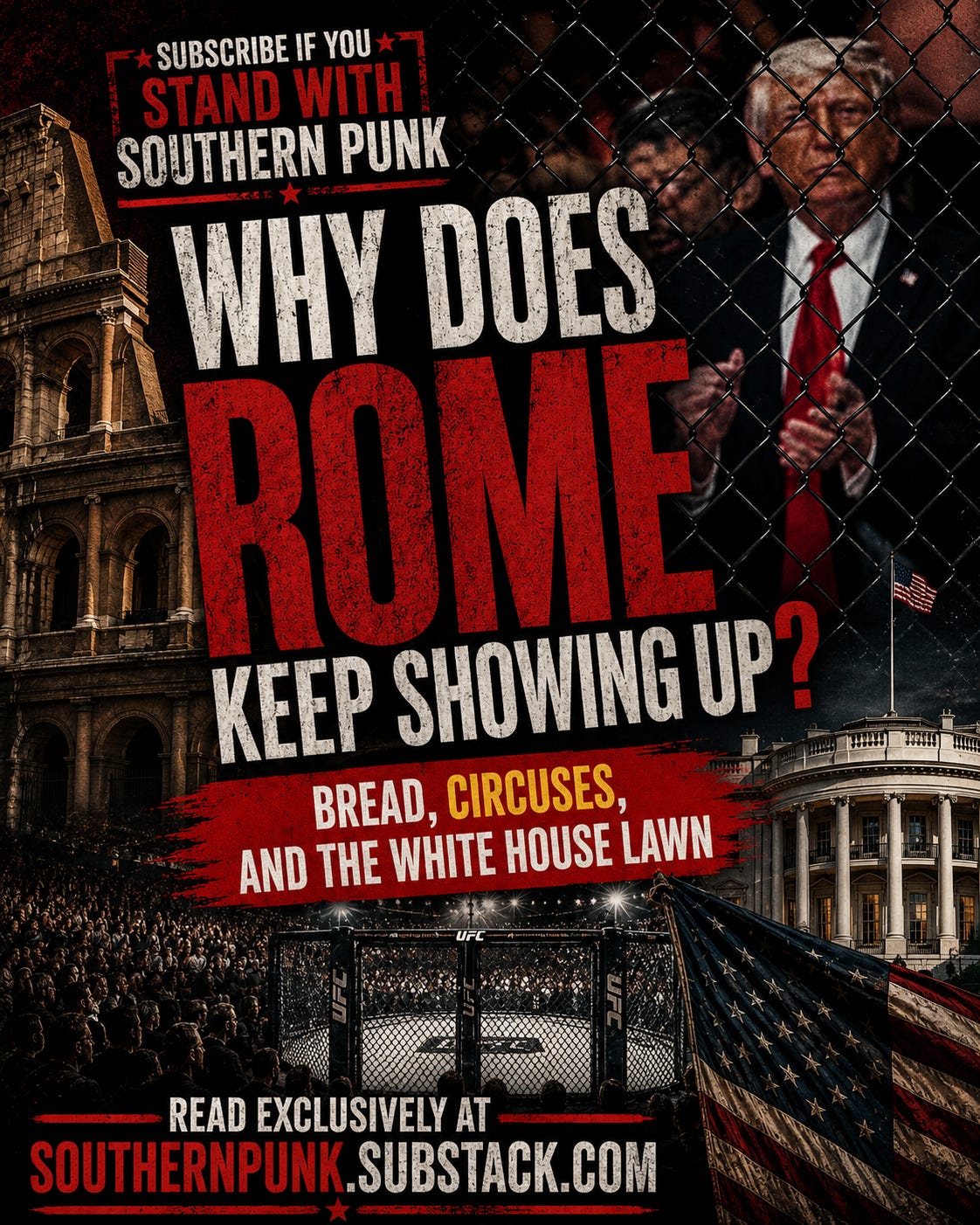
Tomorrow the Secretary of State of the United States is scheduled to sign a memorandum of understanding with UFC. That's a real sentence. In the year 2026. In the United States of America. If you had handed me that headline ten years ago, I would have assumed somebody got drunk and confused government with pay-per-view. Yet here we are. An actual partnership. An actual memorandum of understanding. An actual agreement between the State Department of the United States and the Ultimate Fighting Championship.
Before we go any further, let me make something clear. This isn't an argument against the UFC. It isn't an argument against fighters. It isn't even really about combat sports. Some of the most disciplined athletes in the world step into that cage. They train harder than most people can imagine and dedicate their lives to mastering an extraordinarily difficult craft. This story isn't about them. It's about the symbolism.
Because the more I researched this story, the stranger it became. At first I laughed at the Roman Empire jokes. You know how the internet is. Every third conversation somehow ends up in ancient Rome. So when people started comparing a UFC event at the White House to gladiatorial games, I rolled my eyes and kept scrolling. Then I started reading.
A Cornell classics professor made the comparison. A historian who studies gladiators made the comparison. Sports writers made the comparison. Political writers made the comparison. A major TIME profile raised the comparison. People who agree on almost nothing else kept arriving at the same image. Rome.
The thing that struck me wasn't that one historian saw Rome. Historians compare things to Rome all the time. What struck me was that classicists, journalists, sports writers, political commentators, and historians kept arriving at the same analogy independently. That's usually a sign that the symbolism is doing some of the work on its own. The comparison isn't being imposed on the story. The story keeps inviting the comparison.
That realization led me back to an old phrase: bread and circuses. Most people think it means entertainment. It doesn't. Not exactly. The bread kept people fed. The circus kept people occupied. The point wasn't the games themselves. The point was attention. And once I started looking at this story through that lens, the entire thing felt different.
The giant octagon. The White House lawn. The celebrity guests. The military presence. The television cameras. The promotion. The pageantry. The endless media coverage. Every piece of it is designed to attract attention. That's not criticism. It's observation. The event is literally being promoted as historic. It's being marketed as a once-in-a-lifetime spectacle.
And maybe that's what keeps pulling at me. Not the fight itself. The fact that government increasingly seems to communicate through spectacle. Politics has become something that must constantly compete for attention. Every issue is packaged. Every controversy becomes content. Every public figure becomes a brand. Visibility has become one of the most valuable currencies in public life.
Maybe that's why this story bothers me more than it should. Because I don't remember a time when everything felt this performative. Every institution wants an audience. Every politician wants a viral moment. Every controversy gets transformed into a media event. Sometimes it feels like we're living inside a never-ending competition for screen time.
Maybe that's unfair. Maybe it's simply the reality of modern media. But I miss the idea that government was supposed to be boring. Boring meant people were working. Boring meant budgets were being negotiated. Boring meant infrastructure was being built. Boring meant adults were handling problems. Nobody ever tuned in to watch competent governance because competent governance isn't entertaining.
And maybe that's exactly the point. Government continues whether we're paying attention or not. Budgets get written. Contracts get signed. Policies get implemented. Courts issue rulings. Wars continue. The machinery never stops.
That's one reason the history of Rome keeps lingering in the back of my mind. Because one of the things historians noticed about Roman spectacles is that the games were never really the story. The arena was. The gathering of public attention was.
And that's where history creates a strange problem. The people living through an event almost never know which details will matter later. They don't have hindsight. Only history does. The Romans didn't sit in the Colosseum saying, "We are witnessing a classic example of bread and circuses." They thought they were watching the games. They bought the food. They cheered. They argued. They went home.
It was historians who came later and connected the dots. It was historians who noticed that many of the grandest spectacles appeared during moments of political tension, military setbacks, economic strain, or public dissatisfaction. The people inside the story rarely see the whole story.
I've thought about that a lot over the years. Not because of politics. Because of life. Years ago, during what became my final conversation with my grandfather, my dad's dad, he told me something that completely changed how I understood part of my family's history.
He told me my father had struggled with heroin after returning from Vietnam. Many of the adults around me had known. Many of the decisions that shaped our family had been influenced by it. Suddenly a hundred moments from my childhood looked different. Things that never made sense started making sense. Not because the facts changed. Because the context changed.
Arguments. Choices. Relationships. Outcomes. The story I thought I was living and the story that was actually happening turned out not to be exactly the same thing. That's one reason history fascinates me. The people living through an event rarely know which details future generations will consider important. Understanding arrives later, long after the moment itself has passed.
Which brings me back to the White House octagon. Maybe it's nothing. Maybe it's harmless. Maybe ten years from now nobody will even remember it happened. I genuinely hope that's true. But history teaches us that spectacles are rarely accidental. They are planned. Funded. Built. Promoted. Deliberately placed in front of the public.
And that naturally raises a question. Not an accusation. A question. Why now? Why this? Why here?
The honest answer is that I don't know. Neither do you. That's the uncomfortable part. History rarely explains itself in real time. The understanding comes later. After records are released. After consequences become visible. After historians begin connecting dots that were invisible to everyone else.
Maybe that's why this story keeps pulling at me. Not because I think America is Rome. I don't. Not because I think history repeats itself perfectly. It doesn't. History rhymes more often than it repeats. But human nature remains remarkably consistent.
People are drawn to spectacle. Always have been. We gather around arenas. Stages. Screens. The technology changes. The buildings change. The costumes change. Human nature doesn't change nearly as much as we'd like to believe.
Maybe that's why so many historians keep seeing Rome. Not because America is Rome. But because spectacle is one of the oldest political tools humanity ever invented. Different century. Different costumes. Same temptation.
And here's the thing that keeps me awake. I don't know what future historians will say about this moment. Maybe they'll see it as a harmless curiosity. Maybe they'll see it as a brilliant public relations event. Maybe they'll see it as a footnote. Maybe they'll see it as something much larger. We simply don't know.
That's the curse of living through history. You don't get the answer key. You only get the moment.
Tomorrow the cameras will point toward the octagon. Millions of people will watch. Some will cheer. Some will laugh. Some will be outraged. Most of us will move on within a few days. That's usually how spectacles work.
But history has a habit of returning to moments like these years later and asking a simple question: What was everyone looking at? And what weren't they looking at?
I don't know the answer yet.
That's the point.
We're still living inside the question.
The fight isn't the story.
The attention is.
Support the Porch
There are pieces you write because a headline catches your attention.
And then there are pieces you write because a headline won’t let go.
This was one of those.
Because somewhere along the way, this stopped being a story about UFC. It stopped being a story about Dana White. It stopped being a story about the White House lawn.
And it became a story about something much older.
Attention.
Power.
Spectacle.
The stories societies tell themselves.
And the things they stop noticing while they’re being told.
I didn’t expect that when I started reading. If I am honest, I thought I was going to write a funny piece. Lord knows the headline practically writes its own jokes. The Secretary of State signing an agreement with UFC while a giant octagon sits outside the White House sounds like something a comedy writer would invent after a long night and too much coffee.
Instead, I found myself buried in Roman history.
Reading classicists.
Reading historians.
Reading sports writers.
Reading political commentators.
Reading people who agree on almost nothing else and watching them all arrive at the same place.
Rome.
Not because they were coordinating.
Not because they were copying each other.
Because something about this moment kept pulling them toward the same historical comparison.
And that fascinated me.
Not because I think America is Rome. I don’t. Not because I think history repeats itself. It doesn’t.
But because history has a habit of teaching us things about ourselves.
The further I dug into bread and circuses, the more I realized this piece wasn’t really about ancient Rome at all. It was about us. It was about what captures our attention. It was about what earns our outrage. It was about what dominates our conversations.
And it was about how difficult it can be to tell the difference between the story everyone is talking about and the story that actually matters.
That’s a question I’ve been wrestling with for most of my life.
Not because of politics.
Because of people.
Because families have spectacles. Communities have spectacles. Relationships have spectacles. Every human system has things everybody talks about and things nobody talks about.
And sometimes the thing nobody talks about ends up explaining everything.
That’s one reason this porch exists.
Because Southern Punk was never built to tell people what to think. It was built to ask questions. To slow down. To dig deeper. To look underneath the obvious story and ask whether there might be something else worth noticing.
That’s what we’ve been doing here since the beginning.
One porch conversation at a time.
One story at a time.
One question at a time.
And somehow, against all odds, thousands of y’all decided to pull up a chair.
That still amazes me.
Especially because Southern Punk wasn’t built by investors. It wasn’t built by corporations. It wasn’t built by consultants. It wasn’t built by political organizations. It wasn’t built by media companies.
It was built by readers.
It was built by people who still believe curiosity matters.
People who still believe context matters.
People who still believe that understanding something is more important than winning an argument about it.
That’s rare these days.
And I don’t take it for granted.
If this piece spoke to you, here’s how you help keep this porch alive.
Share it.
Share it with the history nerd in your life. Share it with the person who loves asking uncomfortable questions. Share it with the friend who always notices the thing everybody else missed. Share it with somebody who has ever looked at a headline and thought:
“Wait a minute. Is that really the story?”
Every share helps another person find the porch.
Every share widens this conversation.
Subscribe.
Free subscriptions help the porch grow. Paid subscriptions help keep it independent. They help keep this place curious. They help keep this place honest. They help make sure I can continue following stories wherever they lead instead of wherever somebody else wishes they would go.
And if you’d like to help keep the porch light burning, you can also support the Porch light directly through Buy Me a Coffee.
https://buymeacoffee.com/southernpunk
That support helps fund the research. The reading. The writing. The late nights. The stacks of books. The endless tabs open in my browser. The rabbit holes that start with a headline and somehow end in ancient Rome.
Most of all, it helps keep this place human.
And I think we’re all hungry for a little more humanity these days.
Thank you for reading.
Thank you for questioning.
Thank you for caring enough to sit with ideas that don’t fit neatly into a headline.
Thank you for helping build a community where curiosity still has a home.
Because that’s what this porch really is.
A place for people who aren’t afraid to ask one more question.
And as long as y’all keep showing up, I’ll keep the porch light on.
This IS the People’s Porch. 🪑
Sources With the Lights On
Everything in this piece is grounded in publicly available reporting, historical context, commentary from classicists and historians, sports reporting, political commentary, official statements, and background research on Roman spectacle, bread and circuses, and the White House UFC event.
Nothing in this piece claims America is Rome.
Nothing in this piece claims the White House UFC event is the same thing as ancient gladiatorial combat.
Nothing in this piece claims the government is hiding one specific policy, event, or decision behind this spectacle.
Nothing here claims every spectacle is automatically sinister.
And nothing here asks readers to accept my conclusions simply because I reached them.
This piece is about symbolism.
It is about spectacle.
It is about attention.
It is about why so many people from different backgrounds kept arriving at the same historical comparison.
The facts are sourced.
The opinions are mine.
The concern is mine.
The conclusions are mine.
You are free to reach your own.
These are the receipts.
State Department, UFC, and the Memorandum of Understanding
New York Post | “Rubio and UFC Will Sign Deal to Use Cage Fights for Diplomacy”
https://nypost.com/2026/06/08/us-news/rubio-and-ufc-will-sign-deal-to-use-cage-fights-for-diplomacy/
EssentiallySports | “U.S. Government Turns to UFC for Global Diplomacy in Unprecedented Deal”
RTTNews | “Rubio To Sign MOU With UFC To Enhance Sports Diplomacy Initiatives”
Newsmax | “Rubio, UFC Reach Sports Diplomacy Deal”
https://www.newsmax.com/newsfront/marco-rubio-dana-white-agreement/2026/06/08/id/1258978/
MSN | “Rubio Defends UFC Trip Amid Iran Talks Absence Criticism”
White House UFC Event, Dana White, and Event Background
TIME | “How Dana White Took the UFC From the Fringes to the White House”
https://time.com/article/2026/05/26/dana-white-ufc-white-house-fight-interview/
Yahoo Sports / SB Nation | “Dana White Graces Cover of TIME Magazine Ahead of UFC White House, Reveals Big Fight He Wanted to Add to Lineup”
Inc. | “How UFC’s $60 Million Event Landed on the White House Lawn”
Ms. Magazine | “Trump’s White House UFC Fight Is a Master Class in Fake Populism”
https://msmagazine.com/2026/06/09/trump-white-house-ufc-fight-dana-white-working-class-men/
Rome, Gladiators, and the White House Comparison
Cornell University Media Relations | “The Cageside Emperor”
https://www.cornellpolicygroup.org/post/the-cageside-emperor
Yahoo Sports / Uncrowned | “‘Elite Politics’: Why UFC at the White House Has So Many People Thinking About Ancient Rome”
Bread, Circuses, and Political Spectacle
Medium | Jyothikrishnan K S Achary | “Bread, Circuses, and Capital: Unraveling the Distractions of Power”
Brewminate | “Bread, Circuses, and Scapegoats: Cultural Distraction and Political Power in the Ancient World”
Wikipedia | “Spectacles in Ancient Rome”
https://en.wikipedia.org/wiki/Spectacles_in_ancient_Rome
U.S. History.org | “Gladiators, Chariots, and the Roman Games”
https://www.ushistory.org/civ/6e.asp
History Hit | “Bloodsport and Board Games: What Exactly Did Romans Do for Fun?”
https://www.historyhit.com/what-did-romans-do-for-fun/
WorldAtlas | “Roman Gladiators: Common Criminals and Star Athletes”
https://www.worldatlas.com/ancient-world/roman-gladiators-common-criminals-and-star-athletes.html
Discentes / Penn Classical Studies Publication | “Beyond the Gladiator: A Guide to Ancient Roman Sports”
https://web.sas.upenn.edu/discentes/2023/09/17/beyond-the-gladiator-a-guide-to-ancient-roman-sports/
Why This Piece Focuses on Attention Rather Than Certainty
One of the easiest mistakes a writer can make is pretending to know more than the evidence supports.
I am not claiming to know exactly what future historians will say about this moment.
I am not claiming to know what, if anything, this spectacle may distract from.
I am not claiming one specific hidden decision sits behind the curtain.
The point is more careful than that.
History teaches us that major spectacles often become more understandable in hindsight than they were in real time.
The people living through the moment do not have the answer key.
They have the event.
They have the noise.
They have the arguments.
They have the spectacle.
The context often comes later.
That is why this piece asks questions instead of making accusations.
Why now?
Why this?
Why here?
Why does Rome keep showing up?
Read the Sources
Read the reporting on the memorandum of understanding.
Read the State Department language.
Read the coverage of the White House UFC event.
Read the TIME profile.
Read the sports reporting.
Read the classicists.
Read the historians.
Read the background on Roman spectacle.
Read about bread and circuses.
Read about how public entertainment, political power, and attention have intersected across history.
Then ask yourself the question sitting underneath all of it:
Why did so many unrelated observers look at this moment and immediately think about Rome?
That is the question that kept me sitting on this porch long after I finished reading.
— Southern Punk
If you've read this far, thank you.
Seriously.
The fact that you were willing to spend part of your day sitting with a question instead of chasing the next headline tells me something important about you.
It tells me you're curious.
It tells me you're thoughtful.
And it tells me you still believe some conversations are worth having, even when there aren't easy answers waiting at the end.
That's what this Porch has always been about.
Not telling people what to think.
Not handing out talking points.
Not demanding agreement.
Just pulling up a chair and asking one more question.
And in a world increasingly designed to keep us distracted, I think that's a pretty radical act.
If this piece gave you something to think about, please share it.
Share it with the history nerd in your life.
Share it with the friend who always asks, "Wait a minute... is that really the story?"
Share it with somebody who still believes curiosity is worth protecting.
Because every share helps another person find the Porch.
And every person who joins the conversation helps keep thoughtful spaces alive.
Thank you for reading.
Thank you for caring.
Thank you for proving that attention can still be given instead of taken.
And thank you for helping keep the porch light on.
This IS the People's Porch. 🪑❤️
Now I better wrench my eyes away from the spectacles & go get busy. The garden awaits... I'm looking forward to mixing up soil & potting up some flowers. 🌿💚🌿